RAILWAYS AND SUBWAYS MONITORING
Railways and Subways Structural Health Monitoring (SHM) System by SBDS offers our customers market leading technology to accurately and efficiently monitoring their railway and subway infrastructure. Let SBDS rapid deployment services assist your organization with a monitoring scheme to ensure detection failures network-wide.
OVERVIEW
With cities across the world adopting metro rail networks, accidents occurring during the construction, maintenance, and operation of these networks (metro bridges, tunnels, stations pedestrian structures) have become common. Many of these preventable accidents cause loss of life, limb, and money as well as valuable time. A robust monitoring system to detect damage and design conformance during and after construction must be implemented.
Subways Structural Health Monitoring (SHM) effectively to provide a comprehensive surveillance program that can improve safety and reliability, and reduce the cost of maintenance and rehabilitation.
A well-designed Subways SHM program can help estimate the real-time condition of the structure of metro bridges, tunnels, stations pedestrian structures and determine the level of design conformance, damage detection due to cracking, corrosion, soil stresses, leaks, or other material or structural failures and thus determine when to conduct preventative maintenance and estimate the remaining service life.
At the heart of Railways and Subways SHM System design is to enhance the safety and reliability of high-speed transportation with a continuous and accurate monitoring system.
To do this, we utilize leading technology, such as Fiber optic sensor technology, to provide a flexible system that can be implemented along existing rail infrastructure.
Fiber optic sensors offer advantages over traditional track circuit technology. Utilizing Fiber-optic sensor technology, these small fibers (< 1mm diameter) can be bonded to existing rail without disruption by existing equipment. In the event of a rail breakage, photo detectors within the network will automatically pinpoint the breakage to within a meter for ease of troubleshooting and repair.
ELEMENTS OF RAILWAYS AND SUBWAYS MONITORING SYSTEM

ELECTRO-OPTICAL CONVERTER

SENSORS ON STRUCTURE

OPTICAL-ELECTRIC CONVERTER

DATA ACQUISITION SYSTEMS

DATA TRANSFER AND STORAGE MECHANISM

DATA MANAGEMENT
DATA INTERPRETATION AND DIAGNOSIS
THE BENEFITS
The Monitoring System of Railways and Subway will provide rapid detection of any rail breaks, rail buckling, train presence and speed detection, weigh-in motion, wheel flat spot detection and fire detection in the real time. You will get every piece of information you need to allocate the exact spot and identify the nature of the problem, so that you can make an informative decision.
1
INTEGRATED
SOLUTIONS
Deliver complete solutions using fiber-optic and innovative, high degree of freedom (DOF) sensors.
2
ENSURE THE INTEGRITY OF THE STRUCTURE & SAFETY OF THE USERS
Reliable data collection and analysis will detect early performance degradation in a timely manner, to limit risk and effects of potential disasters.
3
EXTEND LIFETIME OF AGING RAILWAYS AND SUBWAY
Monitor railways and subway accurately to determine the current condition of the rail tracks and structure in order to allow the owners to increase safety margins without any interventions.
4
RELIABLE LONG-RANGE MONITORING 24/7 IN REAL TIME
- Rail Break Detection
- Rail Buckling Detection
- Train Presence & Speed Detection
- Weigh-in motion & wheel flat spot detection
- Fire detection
5
IMPROVED KNOWLEDGE ON RAILWAYS AND SUBWAY DESIGN
Increase knowledge on the structural behavior infrastructure of railways and subway with particular reference to the optimization of materials used and new technologies.
6
IMMEDIATE ASSESSMENT OF SAFETY AFTER A MAJOR EVENT
Monitor damage or failure caused by extraordinary events such as a fires, earthquakes and explosions. This allows engineers and consultants to make preliminary structural assessments of metro bridges, tunnels, stations pedestrian structures
SENSORS USED
Our philosophy is simple: the sensing system needs to match the reality of its environment. Given that a point in space has six degrees of freedom (DOF), our solution has been to match this complexity with an integrated combination of sensors that can be deployed to suit each customer’s unique needs
- 3DOF Inclinometers
- 4DOF Accelerometers
- Strain gauges
- Humidity sensors
- Weather station
- Piezometers
- Distributed Fiber Optic sensors
WHAT MONITORING APPROACH IS RIGHT FOR YOU?
The Railways and Subway Structural Health Monitoring (SHM) system can be deployed to effectively address both continuous monitoring and portable testing needs.
Customers seeking a dynamic system to perform diagnostics on the current health of a structure will achieve their goals with the Railways and Subway SHM system.
For customers looking to collect data and provide ongoing information on the behavior and health of their structure, the SHM platform is ideally suited for long-term monitoring needs
WHAT WE PROVIDE
At Railways and Subway SHM system we provide innovative solutions that serve our customers needs through ultra-reliable performance and long product life. We believe in providing clear information about each service we offer, and the standards we aim to achieve

DESIGN & PLANNING
Our team of experts will work closely with you during design, technology selection, and system optimization

INSTALLATION & COMMISSIONING
Railways and Subway SHM system provides service and support during and after installation, with a wide range of additional services and extended global warranties for every system we supply

SERVICE & SUPPORT
Railways and Subway SHM system provides ongoing technical support from installation, commissioning and beyond

REAL TIME MONITORING
Railways and Subway SHM system provides a unique approach to structural health monitoring of metro bridges, tunnels, stations pedestrian structures, delivering real-time data and analysis for our customers to reduce downtime by monitoring assets and notifying key members before it reaches a critical state
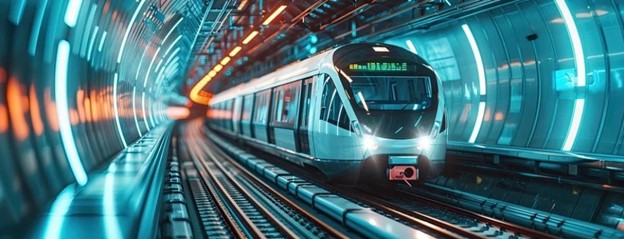
Subway Structural Health Monitoring (SHM) system subdivides a metro rail network into its structural components and the conditions under which they are to operate safely and reliably, the type of monitoring required, and the available methods. Subway (SHM) system also includes a comprehensive monitoring program for determining the general health of the metro rail network.
Local Components
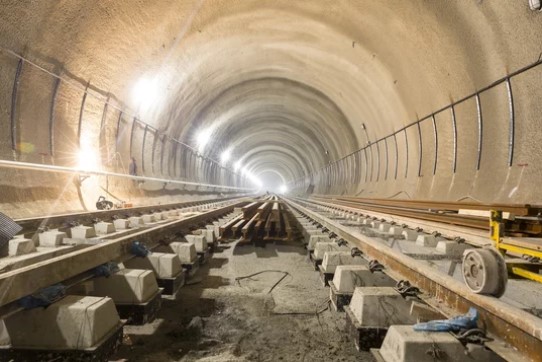
Underground SHM techniques are employed for underground components for asset protection (safety of existing nearby structures) and monitoring ground movements (due to soil pressure and water seepage) to ensure safety.
Station box
The station box is an underground hub consisting of excavation and lining. Depending on the type of soil either diaphragm walls or contiguous pile walls are constructed to retain the surrounding soil and are subjected to flexural stresses. Measurement of lateral earth pressure in the walls/piles can be done using strain gauges. Piezo-impedance transducers can be used to extract incipient structural damage characteristics in structures.
This helps in the detection of flexural or shear cracks before they appear. Extensometers can be used to measure the convergence or divergence between two fixed points or between multiple points. Accelerometers can be used to measure dynamic response due to external vibrations and/or seismic activity. Temperature sensors are also used to estimate thermal changes and the resulting expected expansion and shrinkage in the structure.
Shaft
The shaft is a circular passageway for ventilation and assembly of tunnel boring machine. The shaft lining is subject to earth, water, and rock pressures. The local stresses on the shaft lining can be estimated using linear variable differential transformers. Piezo-based sensors are also available to monitor the pressure on the lining. These sensors can be used to measure direct pressure as well as leaks, by measuring the change in pressure over time.
Tunnels
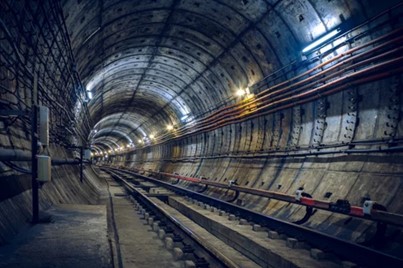
Tunnels are excavated with a tunnel boring machine and lined with concrete. Settlement of the tunnel lining can be monitored using tilt meters and inclinometers. They provide information on small movements that occur in the lateral direction as well as vertical settlements. During construction, they can also be used for course correction before irreparable damage is done.
Piezo-based sensors can be used to monitor earth pressure on the lining during and after placement. Pressure transducers can also be used to monitor the soil pressure on the tunnel lining.
Pore pressure meters can also be used to measure the pore pressure in the surrounding soil around the lining. Corrosion of reinforcement steel also needs to be monitored.
Electrochemical sensors commonly use linear polarization resistance to quantify corrosion rates. They can also be designed to monitor the pH and redox potentials of the concrete pore solution to determine the corrosion potential.
Fiber optic sensors are also used to detect reinforcement corrosion and act as an early warning sensing system. Fiber optics-based polymer hydrogel sensors can be used to detect moisture to determine the relative humidity. It is possible to monitor large sections of a tunnel or even the entire tunnel using this system. It is also possible to monitor the temperature in the tunnel using a similar set-up.
Strain gauges can be used to monitor the re-opening of joints and to monitor the appearance and growth of cracks. Deformation in the rock mass and adjacent surrounding soil during boring can be measured using borehole extensometers.
Loads on the rock bolts and anchors can be instrumented using load cells. They can also be used to measure the stresses in supporting elements such as struts and ribs.
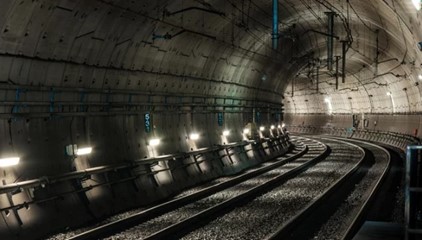
Railway tracks
Rails are subject to very high stresses from the movement of trains, heat, the curvature of rails, exposure to the environment, etc. Cameras and lasers mounted on a truck that can run on the rails can provide information on lateral displacement, blockage, and surface deformations in the rails.
Fiber-optic sensors can be used to instrument the entire length of the tracks allowing for real-time condition monitoring of the entire network. The longitudinal forces on the rails from the train movement, strain, the temperature can be measure dusing fiber optic sensors on the rail surface. Brillouin scattering-based sensors can also be used to monitor the strain and modulus of the rails.
Acoustic Emission (AE) sensors detect transient elastic waves released by a material when it undergoes a sudden stress response to external or internal loads. They are used for detecting damage in rails, by monitoring crack formation and evaluation from loading stresses on the rails as well as material durability issues such as corrosion. Guided ultrasonic waves can also be used to detect material flaws and deformation in rails