Sectors
Fiber optic Sensors
Fiber optic strain gauge
The basic sources of information in Bridge Structural Health Monitoring System, which record various changes in the condition of bridge structures, are fiber-optic strain sensors.
They are the most effective for continuous monitoring during long term operation; they allow to obtain information about the internal condition at any point of the structure; they generate signals that provide accurate data on the localization of defects, the degree and type of deformations; they work effectively in interference conditions
Operating principle of a fiber optic sensor
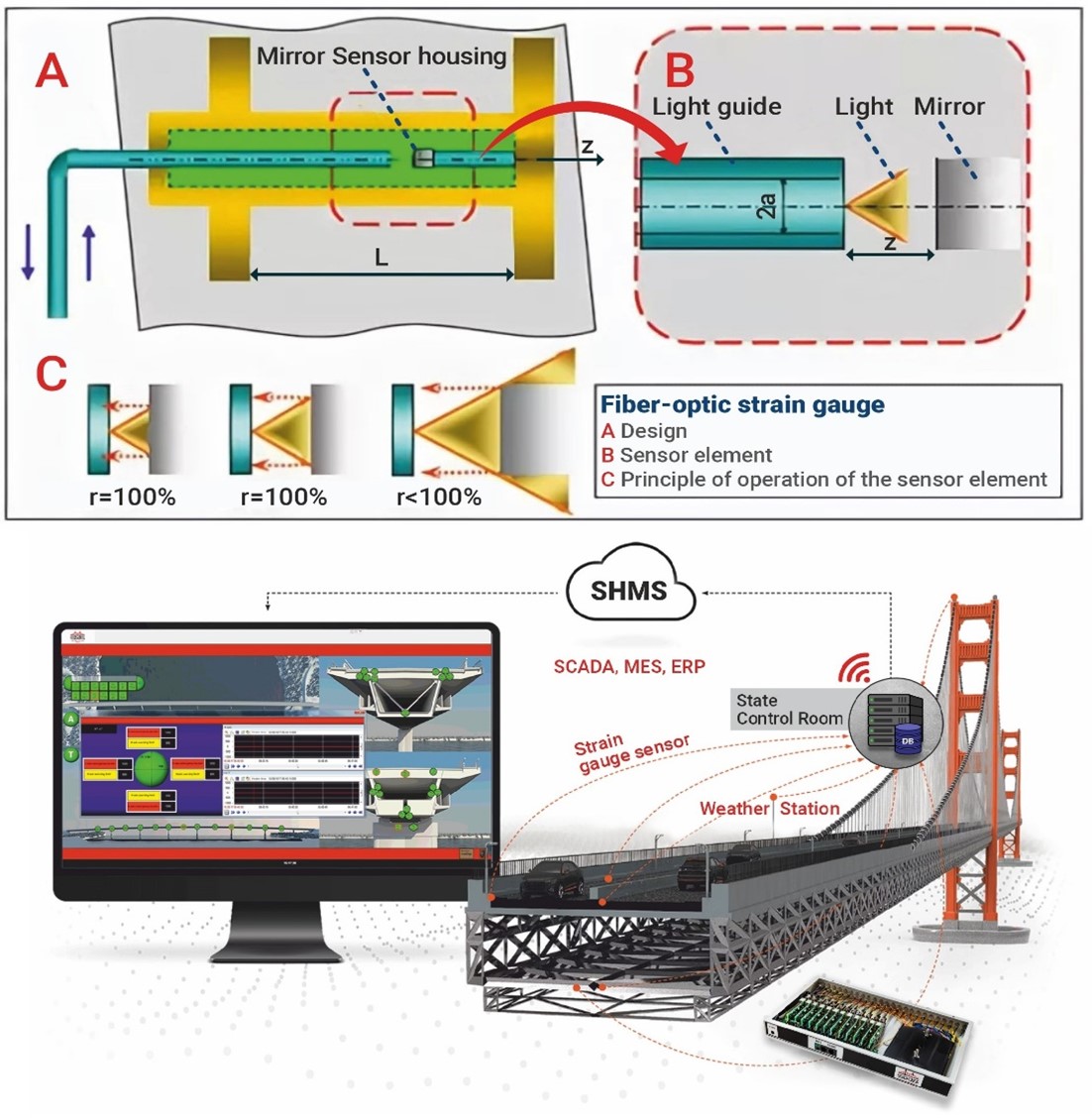
The deformation value of the bridge structural element controlled part is determined by the operation of the sensitive element of the fiber-optic sensor based on the light transmission coefficient dependence on the change in the curvature of the light guide section.
The intensity value of the registered light flux, converted by the photodetector into electrical voltage, after processing with the help of a special program, gives the deformation value.

Fiber optic strain sensors have obvious advantages over sensors operating on other physical principles:
- Measurement accuracy (10 times more accurate)
- Durability (service life not less than 20 years) 3
- Installation method and operation method that does not require destruction of the structure
An additional advantage is compliance with stringent requirements related to operating conditions:
- Maintain accuracy under environmental temperature fluctuations
- Resistant to high humidity
- Resistant to mechanical vibrations typical of bridges
In addition, in order to be able to create a Bridge Structural Health Monitoring System (SHMS) used on the bridge, the design of sensors as part of the measurement system should provide for:
- Absolute fire and explosion safety
- Ability to transmit data over a long distance without distortion (up to 3 km without additional equipment)
- A topology in which the failure of a sensor does not lead to the failure of the entire system
- The possibility of operation without power supply

Measurement system
Measurement system
Strain measurement complex is designed to monitor the deformation of the controlled bridge structure. It consists of two structural parts: a rod fiber optic deformation sensor (RFODS) and a fiber optic sensor signal meter (FOSSM), which are connected by means of a fiber optic cable (FOC).
The RFODS converts the deformation of the bridge structure being monitored into a corresponding change in the characteristics of the radiation traveling in the fiber optic sensing element. FOSSM is designed to register the signal from fiber optic sensors and transfer the results to the server for data processing.

Installation of sensors (topology) is regulated at the project stage in the points of potential source of destruction of the structure (areas of the highest loads, places of support, joints, attachments)
The electronic signal processing unit receives constant information about the condition of the structure at the set control points. Sensors are polled automatically and at a set time interval of once every two seconds. Comparison of this information with the design data in a constant mode allows to draw conclusions about the technical condition («health») of the bridge structure.
At the same time, the analysis is performed by numerical modeling of the state of the bridge structure with actually measured data, which are put into the calculation. The obtained result allows to understand how the bridge structure as a whole has deformed. The principle of Bridge Structural Health Monitoring System (SHMS) data extrapolation: information is provided only on local deformations, and conclusions can be drawn on changes in the bridge structure in general

Scheme of SHMS measurement system operation
Operation description of the Bridge Structural Health Monitoring System (SHMS) measurement system
- The signal meter (FOSSM) generates a light pulse sent to each RFODS strain sensor for interrogation.
- The primary transmitter of each sensor introduces a perturbation to the sent signal according to the parameter to be recorded.
- The photodetector of the fiber optic sensor signal meter detects the return (analog) pulse, converts it into an electrical signal, and transmits it to the Bridge Structural Health Monitoring System (SHMS) server.
- The Bridge Structural Health Monitoring System (SHMS) server provides processing of the received data from the measuring system, saves it to the database, and compares it with the specified limit values.
- The bridge operator’s displays information on changes in the stress-strain state of the bridge structure in the form of relative (actual) deformations.
- Notifications on exceeding the limit values for each bridge are sent to the State control room or Federal agency for management decisions.
Bridge monitoring principle
The main elements of a bridge are supports and spans.
The span is the main load-bearing structure designed to absorb permanent and temporary loads from road traffic, human traffic, rolling stock and transfer them to the supports.
The support part is designed to provide deformation freedom of the span and transfer the load from the span to the support in a strictly fixed place
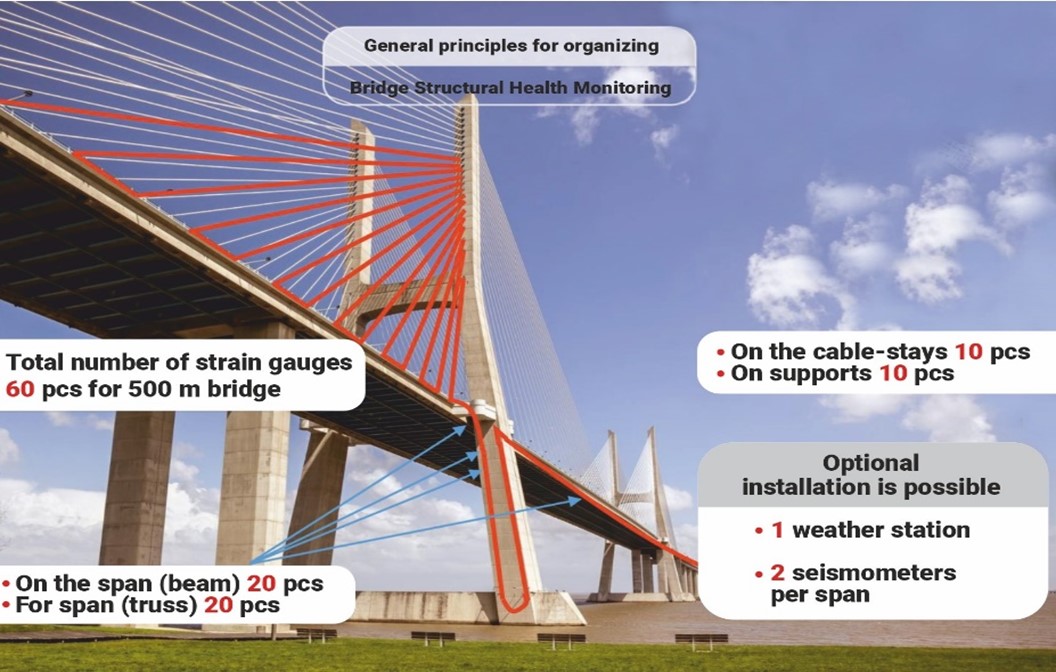
General principles of bridge monitoring system organization
Based on the above described bridge design, the following monitoring system configuration is optimal.
The specified distribution is only general. The exact number and installation locations are determined by the design solution
Tunnel monitoring principle
General principles of tunnel monitoring system organization.
In order to ensure comprehensive safety during construction and operational reliability during subsequent operation of transportation tunnels, it is particularly important to continuously monitor the deformations and stresses occurring in the surrounding soil mass.
The settlement of the soil mass caused by tunnel construction depends on: the size and depth of the tunnel, the methods and speed of mining operations, hydrogeological and geological conditions, the timeliness of filling the voids behind the tunnel lining and a number of other factors.
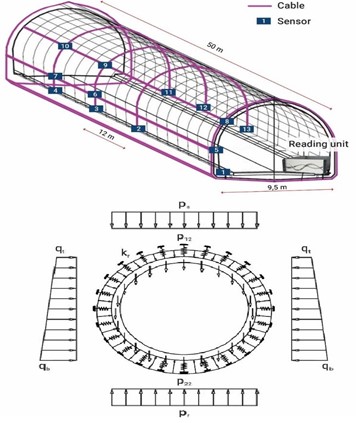
Example of arrangement of strain gauges in a tunnel section
The automated monitoring system is a group of deformation sensors, which allows to determine a wide range of data from both the tunnel itself and the surrounding soil mass. One of the significant advantages of this approach is the flexibility in selecting the number and location of the system sensors at the site.
High accuracy of measurements is related to the characteristics of the sensors used and the mathematical algorithm of the programs used in their processing. Based on the obtained monitoring data, recommendations are developed to ensure regular and safe operation of the transportation tunnel